
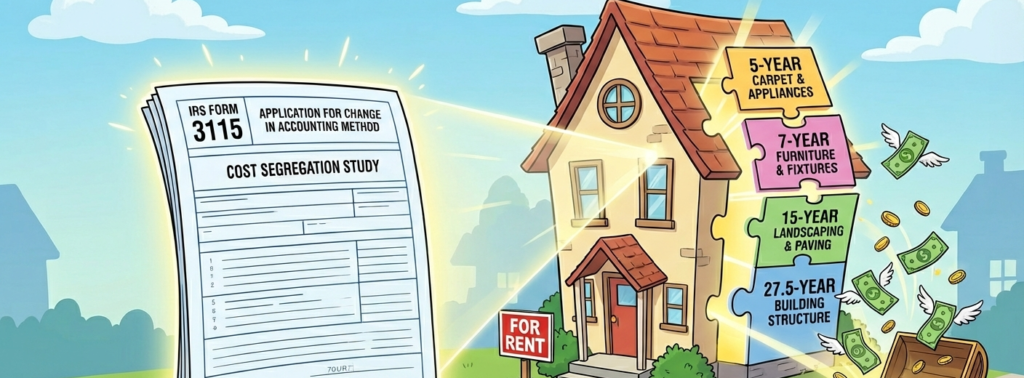
A cost segregation study can significantly accelerate depreciation deductions for rental property owners, allowing you to claim larger tax benefits earlier rather than spreading them over the traditional 27.5- or 39-year recovery period. But what happens if you already placed the property in service and filed past tax returns using a different depreciation method?
In most cases, the solution is Form 3115, Application for Change in Accounting Method. Below is a practical overview of when the form is required, the basic filing requirements, and the steps involved.
When Form 3115 Is Required
If you complete a cost segregation study in the same year the property is first placed in service, implementation is straightforward—you simply use the study’s asset classifications when setting up depreciation. However, the process becomes more complex once tax returns have already been filed using the original depreciation method.
- Only one prior tax return filed:
You may chose to either amend that return to apply the cost segregation study or file form 3115 to implement the change in the current year. Taxpayers may chose the form 3115 approach because it allows the cumulative missed depreciation to be recognized in the current year—potentially producing a larger tax benefit if income (and tax rates) are higher now than in the previous year. - More than one prior return filed:
The IRS does not allow multiple amended returns for this type of depreciation change. Instead, you must file form 3115 to request an automatic accounting method change.
What Form 3115 Does
Form 3115 allows you to retroactively correct depreciation by calculating a Section 481(a) adjustment. This adjustment represents the difference between the depreciation you actually claimed, and the depreciation you would have claimed if the cost segregation study had been used from the beginning. For most cost segregation changes, this adjustment is negative—meaning it reduces taxable income and creates an immediate tax benefit in the tax year that you file the form.
How to File Form 3115
Filing form 3115 to implement a cost segregation study can unlock substantial tax savings—but the process is technical and documentation-heavy. These are the steps:
- Filling out the 3115 form. The form is 8 pages total, but only some sections are applicable to applying a cost seg study.
- Attach required statements. The 3115 form has a number of questions that require attaching additional information and statements. IRS revenue procedure 2022-14 provides information on what statements are required for various situations, including to correct past depreciation.
- Create prior and proposed depreciation schedules. Generate depreciation schedules showing the original depreciation method and prior accumulated depreciation, and then the new proposed method using the cost segregation study and the newly calculated total accumulated depreciation using that method. The difference in the accumulated depreciation between those two methods is the section 481(a) adjustment, which also needs to be reported on the 3115 form.
- Put the Section 481(a) adjustment on the tax return. A cost segregation study typically generates an additional tax loss, and that loss is reported on your tax return in the current tax year as an “Other Expense” on your Schedule E.
- Include a copy of the 3154 forum on your current year timely filed tax return. Most consumer tax software like TurboTax doesn’t have a way to generate the form and also attach the required statements. So you will need to either paper file your tax return in order to include the form, or you can instead choose to mail it in separately using form 8453 after e-filing the rest of your tax return.
- Mail in a second copy of the 3115 form. As explained in the 3115 form instructions, the IRS also requires that you mail them a second copy of the form in addition to filing it with your current year tax return.
- State filing if required. Some states with state income tax may also require that you mail a copy of the 3115 form to the state or include it with your state tax return. Some states, such as California, that don’t conform to bonus depreciation may require that you calculate a different Section 41A adjustment that is specific for your state tax return.
If you’re interested in filing the form yourself, we do provide a complete how-to file Form 3115 package that includes a half-hour long instructional video, a pre-filled form 3115 as an example, a text document with the required attached statements, and a spreadsheet that calculates the prior and proposed depreciation schedules and 481(a) adjustment.
If you’re unsure about eligibility, calculations, or filing procedures, consider working with a tax professional experienced in real estate and the 3115 accounting method changes. We can provide consultation services to help you with the process.
